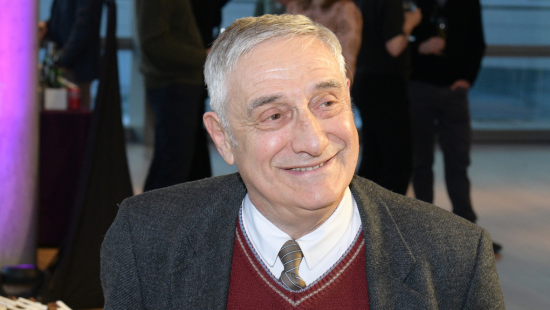
Nobel Prize Winner! A Conversation with and Toast to Joel Mokyr

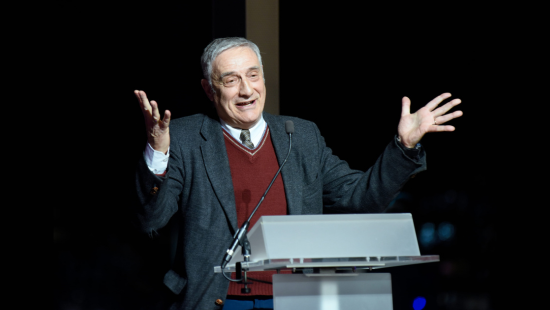
On March 3rd, I had the wonderful opportunity to host our own Nobel laureate Joel Mokyr for a freewheeling discussion with more than a hundred and fifty undergraduates.
The event was co-sponsored by the Department of History, the Department of Economics, and the Roberta Buffett Institute for Global Affairs, and it took place in a very crowded Harris 107.

 Amy Stanley
 Orrington Lunt Professor of History
Director, Nicholas D. Chabraja Center for Historical Studies
A Toast to Joel Mokyr
Given by Prof. Daniel Immerwahr at the Department of History gathering at LeTour in Evanston.
|
|
 |

A Toast by Prof. Daniel Immerwahr
Joel, everyone knows, is an incurable optimist. He has written about how humans have gotten rich, lived longer, and grown, if not measurably happier, than at least less prone to die of dysentery. We often say there’s no such thing as a free lunch. In fact, as Joel writes in one of his books, there is. It’s called technology, and it is the greatest of all free meals.
I have long watched Joel from the opposing trench. I am an incurable pessimist, trained (in the unrelenting sunshine and soft breezes of the University of California, Berkeley) to believe that modernity is a tragedy, not a comedy; that Europe was a perpetrator, not a leader; and that we’re headed for catastrophe, not prosperity.
Or, I arrived at Northwestern believing those things. Then I met Joel. He is a virtuoso of argument, in two senses. First, as his colleagues know, he does not shy from voicing strong opinions and seems to delight in dissent, famously forming both the right wing of the History Department and the left wing of the Economics Department. But he’s also an argumentative virtuoso in the other sense, of being someone who lays out his cases so compellingly that even someone dispositionally disinclined to accept them is swept along. Reading and talking to Joel, I found myself metamorphosizing, from an incurable pessimist to something else: a curable pessimist.
A curable pessimist is still a pessimist, of course. I’m writing a book about environmental catastrophes. But, even still, I have to concede that one chapter rests on quantitative analysis, something Joel helped me do. And another examines the culture of invention among woodworkers, which is about the most Mokyr topic imaginable. In other words, he got to me.
My favorite moment in the JM oeuvre, because it is so distinctively Mokyrian, comes in The Lever of Riches. It’s midway through his chapter on the Industrial Revolution, or as he calls it, the “years of miracles.” He discusses all of the breakthrough technologies that distinguished Europe from its neighbors: the steam engine, blast furnace, and power loom. Fair enough, point made.
Then, unexpectedly, he puts down the power looms and, with a flourish, moves on to an invention that was essentially useless: the invention of ballooning. As a mode of transportation, the hot air balloon has easily the worst ratio of miles traveled to third-degree burns suffered. Yet, even in its total pointlessness, it achieved a long-held dream of humanity: flight.
This is an enchanting passage, all the more so because you imagine Joel saying it with his playful, triumphant smile. So, a toast. May all our arguments rise to the sky like balloons. And here’s to Joel Mokyr, my favorite bag of hot air.
Gallery
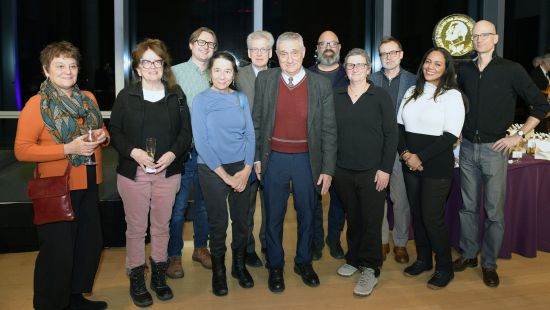
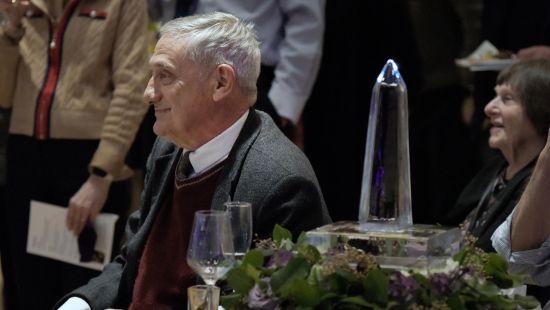
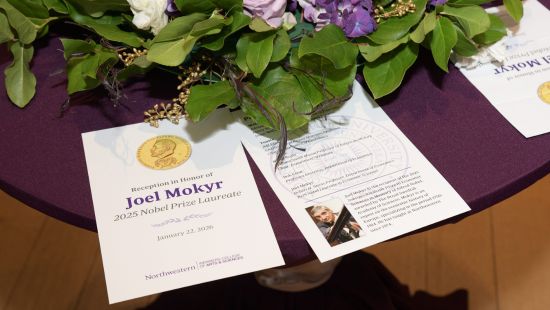
WCAS Reception at the Global Hub in Honor of Joel Mokyr