
Chabraja Center Happenings
Nicholas D. Chabraja Center for Historical Studies
By Elzbieta Foeller-Pituch
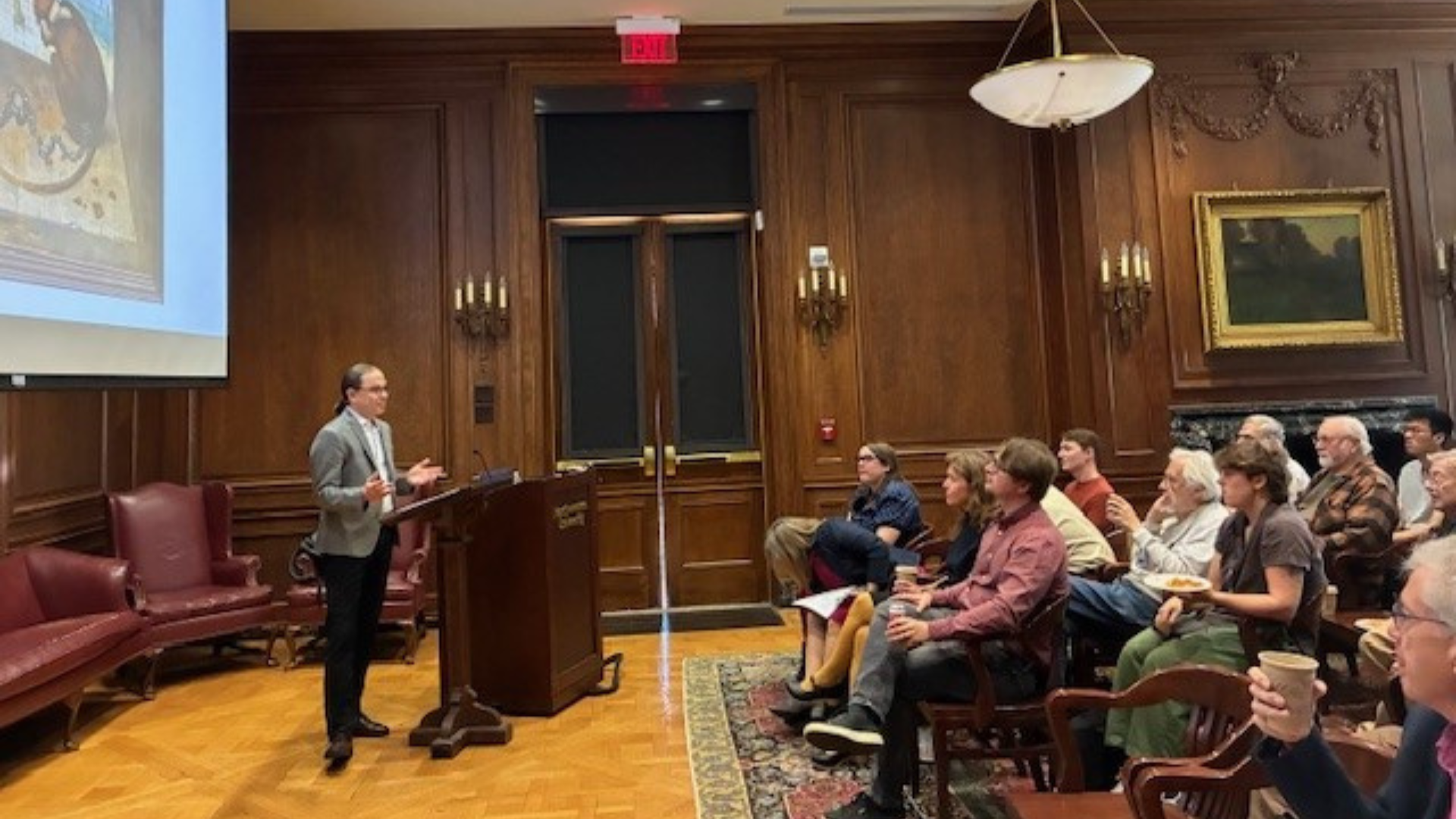 As usual, in 2025-26 the Center had a vibrant lineup of events, including lunch lectures, joint lectures, a variety of cosponsored activities, and an April 2026 faculty conference. We started off our academic year with the annual September “Ice Cream Lecture,” delivered by Scott Sowerby on “Early Modern French Natalism and Other Odd Stories” and yes, there was ice cream.
The CCHS lunch lectures included Jared Farmer (University of Pennsylvania) on “Historians, Avians, and Bird’s-Eye Views,” as well as Sunil Amrith’s (Yale) take on “Climate and Colonialism” and Mexican historian Erika Pani’s talk asking “Does North America Have a Common History? The View from the Nineteenth Century.” Joint lectures with the Holocaust Education Foundation of Northwestern, the Center for African American History, and the Boyce Lecture in Medieval Studies have offered a variety of historical explorations. The joint History/CCHS Fall and Winter faculty workshops allowed Northwestern historians to present their work-in-progress and receive valuable feedback from their peers and graduate students. The topics ranged from an examination of “The Jet-Age Refugee” (Lauren Stokes) to the problems of stillbirth registration in the United States (Susan Pearson). In addition, the Center organized an exceptionally well-attended and lively January panel discussion on “Generative AI and History: Research, Writing, and Teaching” featuring Emily Kadens, Daniel Immerwahr, and Robin Bates.

CCHS held its annual event celebrating newly published books by Northwestern historians to coincide with the March 2026 visit of prospective History graduate students to the university. Newly published books were on display, and several authors (including 2026 Nobelist Joel Mokyr) said a few words about their books. This year’s CCHS faculty conference was on “Religious Pluralism and Rulership in Early Modern Eurasia” (April 2026).
The CCHS global partnership with the School of History at Queen Mary University of London (QMUL) brought a group of graduate students and faculty from London to Evanston in late April. Their visit included faculty new book presentations, a talk about the journal Past and Present for grads and postdocs, and a symposium at which paired NU and QMUL graduates presented their research.
The community of CCHS associates has been made up this year of two Teaching Postdoctoral Fellows, one Postdoctoral Fellow in Public History, three Breen Graduate Fellows and one Quinn Graduate Fellow. Center associates take part in all Center activities and also occasionally meet up for small workshops. Selection of fellowships for the next year—postdoctoral, graduate, and undergraduate, as well as summer CCHS Public History graduate fellowships—is taking place in the present Spring Quarter.
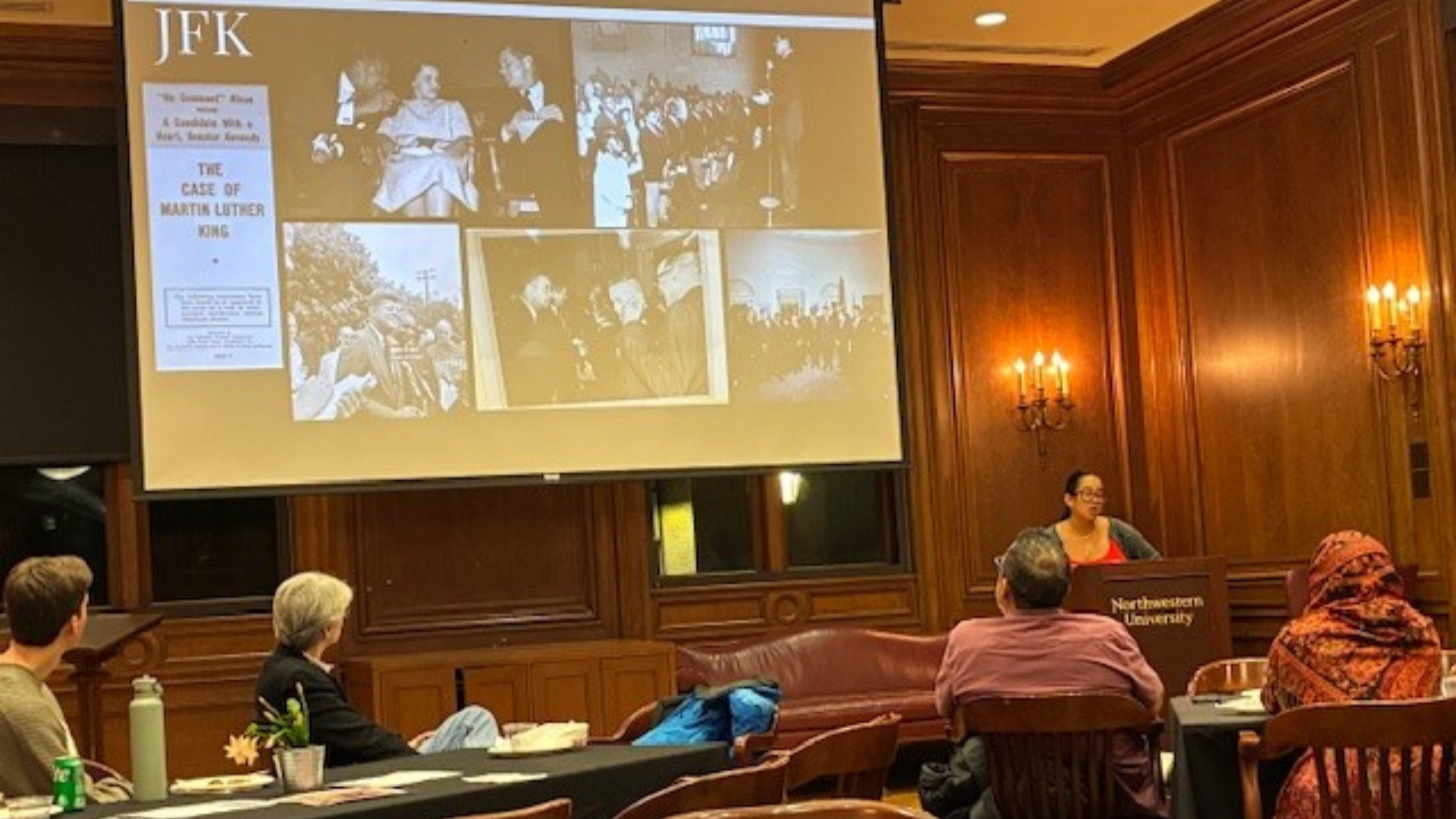
The popular Leopold Fellowship program has allowed 23 undergrads from across the university to work on History faculty projects; at the end of each quarter a group of Leopold Fellows present their research to their peers, faculty sponsors and Center associates. Undergraduates also benefit from the CCHS Teaching Initiative supporting the creation of new, broad-ranging History classes. This year new classes were designed by Kathleen Belew on “The Transformation of Childhood: Politics, Medicine, and Education” and Peter Carroll on “Modern Global Cities.”
In short, this was a successful, active, and varied year. More about it can be found on the CCHS website at https://historicalstudies.northwestern.edu/.
Past Event Recaps:
Caring for the Dead: Ancestor Veneration, Religious Encounters, and the State in the Mongol Empire and Africa
By Sean Hanretta
In April 2025, Professors Brack, Ogundiran, and Hanretta, together with CCHS fellow Dr. Ginestet, convened the CCHS-funded conference "Caring for the Dead: Ancestor Veneration, Religious Encounters, and the State in the Mongol Empire and Africa," with indispensable support from CCHS Director Amy Stanley, Assistant Director Elzbieta Foeller-Pituch, and the staff of the Department of History. The conference brought together scholars from across the world to engage in the first-ever comparative project on ideas and practices related to the dead in the Mongol Empire and various parts of Africa.
The conference organizers made a point of mixing scholars from these two fields, which are usually in separate silos, so that each panel included specialists on both regions. Panels also intentionally cut across the disciplines of history and archaeology, enabling participants to discuss the comparative value of different kinds of traces of the past and how best to integrate the insights we can derive from them. The opening panel set the tone, featuring Stephen Dueppen, a distinguished archaeologist who works on shrine sites in Burkina Faso, and Christopher Atwood, a renowned historian of the Mongol Empire and translator of medieval Mongolian and Chinese documents. Their papers and ensuing conversation—moderated by NU anthropologist Amanda Logan—raised themes that echoed throughout the event: how the places where the dead are buried become sites for legitimating political power; how conquerors manage the sacred spaces of those they vanquish; and how scholars decode the symbolic landscapes of the dead.
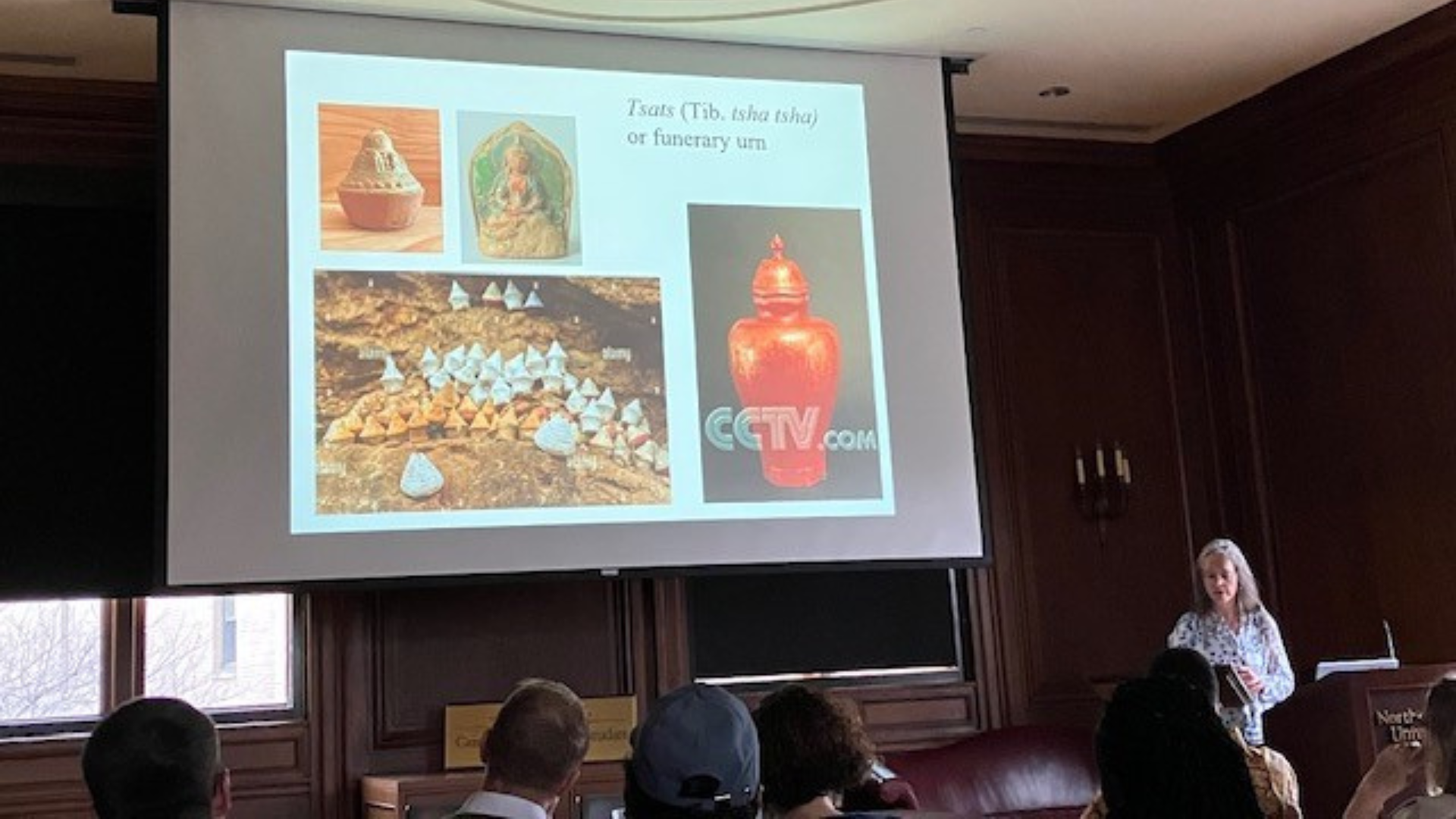
The rest of the first day’s papers—by Dagmar Schäfer, Alicia R. Ventresca-Miller, Chapurukha M. Kusimba, Sibel B. Kusimba, and Isabelle Charleux—used the material culture of death to explore the dynamics of iconoclasm, cultural nationalism, social relations, and imperial cultures. The keynote talk that culminated the first day provided a third instance of “perspective by incongruity” as Florence Bernault of Sciences Po, a historian of modern Africa, offered insights intended to help the assembled specialists in the “deep past” think about their topics in new ways. Her talk highlighted the interplay of mimesis and misprision across both sides of the colonizer-colonized divide, providing a close reading of the forensic techniques of French officials in Moyen-Congo.
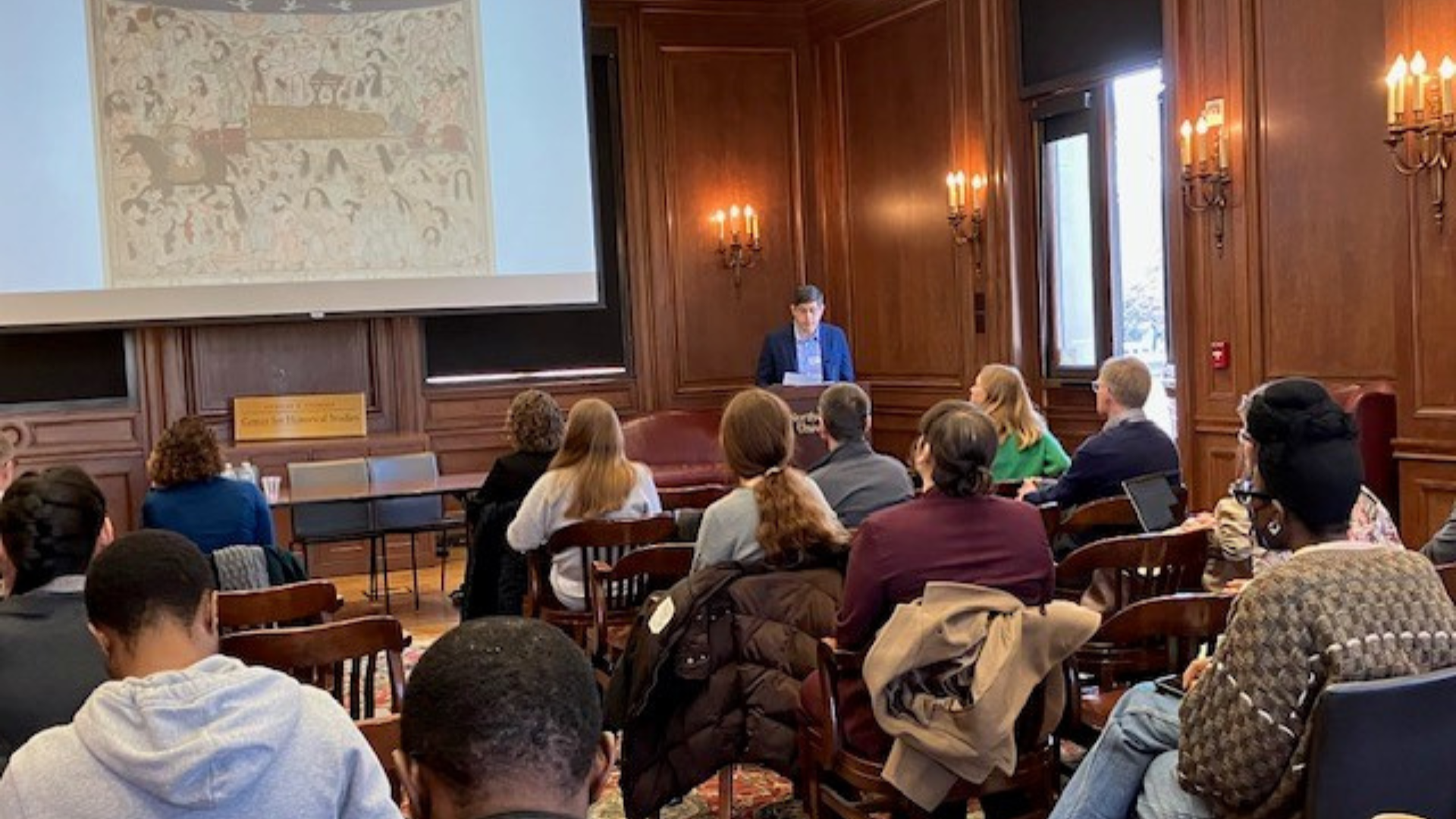
The second day’s panels—featuring presentations from Aurelia Campbell, recent NU PhD Dil Singh Basanti, Bryan K. Miller, Dotno Pount, and lead convener Jonathan Brack—interrogated received understandings of religious and showcased cutting-edge technologies for revealing the “lives of the dead.” Concluding remarks by co-conveners Akin Ogundiran and Sean Hanretta suggested some additional themes for future investigation—including the physical boundaries between the living and the dead and the continuities in burial practices during periods of radical political change—and once again profited from the complementary perspectives of a specialist on the deep past and one on the twentieth century.
Bringing together scholars who might never otherwise speak to one another, the conference revealed the limitations that tight geographic and temporal boundaries can impose on our understandings of phenomena as universal as death and the dead.
Paper People: Documentation, Identity, and Citizenship in U.S. History
By Susan Pearson
In May of 2025, Susan Pearson convened the CCHS conference “Paper People: Documentation, Identity, and Citizenship in U.S. History.” The conference was generously supported with funds from not only CCHS, but also Weinberg College of Arts and Science, the History Department, the Alice Kaplan Institute for the Humanities, and the Society for the History of Children and Youth. CCHS Postdoctoral Fellow Mikala Stokes and CCHS Associate Director Elzbieta Foeller-Pituch provided expert organizational and logistical backing.

The conference brought together 15 academic historians to consider the role of identity documents in creating access to personhood and the rights of citizenship. Documentation of identity is at the heart of modern citizenship. Paper is how individuals are known to belong to a particular nation or, by contrast, to lie beyond its pale. Nations have marked their citizens in a variety of ways – with birth certificates, driver’s licenses, passports, and social security cards – and most require that citizens prove their belonging by displaying these documents across a range of settings, from the DMV to the airport to the city street. Such pieces of paper are the way that individuals access citizenship as it exists in concrete forms – the right to be in a certain place, to travel freely, to attend school, to vote, to gain employment, to receive social welfare benefits and to marry, to name a few. Because documents link the abstract idea of citizenship to the goods of citizenship, they both open and close doors. Throughout U.S. history, citizenship has been marked by inequality and exclusion, and the administration of such inequality has also relied on documents to function.

The conference panelists took up these themes through a wide-ranging set of papers. We heard from historian Dale Kretz about how newly freed slaves navigated the challenges of establishing their paper identities in the wake of the Civil War. Emily Yankowitz analyzed early American forms of identification issues to sailors to protect them from capture and impressment by other nations. Rachel Rosenbloom discussed how Chinese Americans used documents to navigate border crossing during the Chinese Exclusion era. Andrew Wenner Cohen took us through a series of court filings from the nineteenth century in which Americans sought to have their gender identity affirmed by legal documents. Heading further into the twentieth century, Victoria Cain looked at resistance to student IDs during the 1960s and ‘70s, and political scientists Magdalena Krajewska analyzed the implementation of REAL ID requirements after 9/11.
In the year since the conference convened, the political stakes of documentary identification have only become more pressing, and the need for good histories of these practices is all the more necessary. One reason that Pearson convened the conference was to stimulate interest in this history among US historians. To that end, Pearson will be editing a book by the same name as that of the conference, which New York University Press has agreed to publish. Many of the conference attendees will submit chapters to the book, which should hit shelves some time in 2027. Thanks to the generosity of CCHS and other sponsors, the conversation initiated by the Paper People conference will soon be widely available to all.