
Religious Pluralism and Rulership in Early Modern Eurasia
Religious Pluralism and Rulership in Early Modern Eurasia
A CCHS Faculty Conference for Spring 2026
By Alex Barna
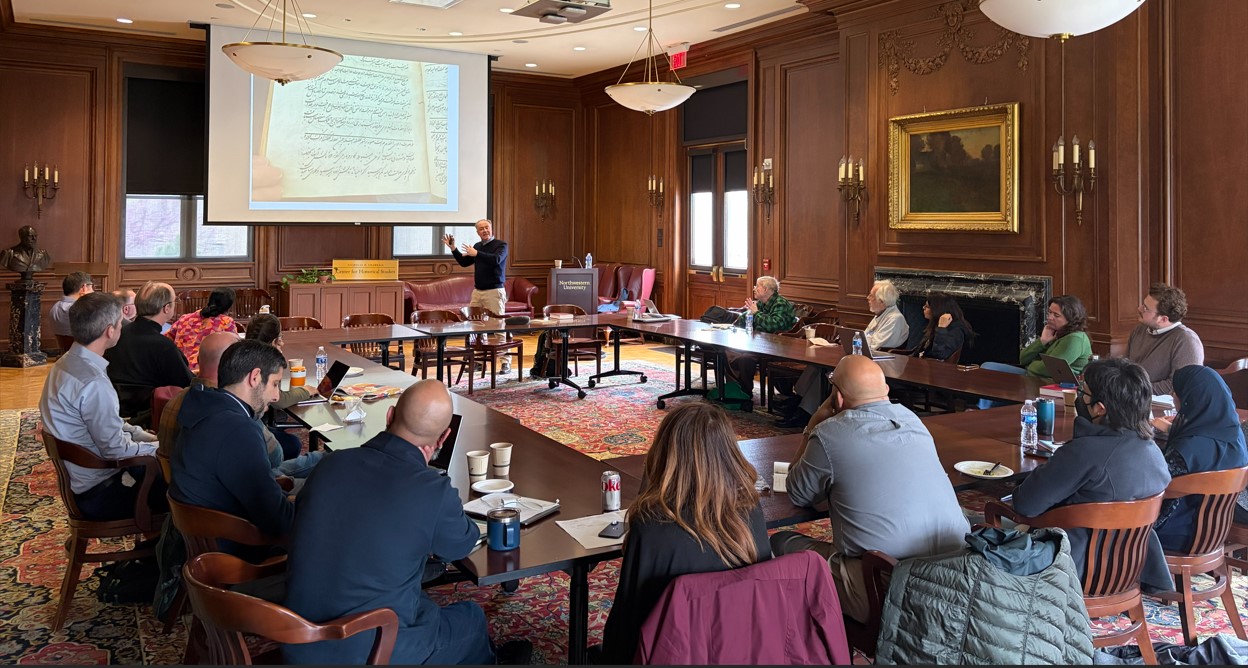
Since the 1970s, scholars have referred to an “Early Modern” period to demarcate a transitional phase of history that separates the medieval era from the modern. Early modernity is now customary in most periodization schemes, whether regional or global, but understanding what precisely makes it cohere as both a distinctive period and a concept remains an unfinished and ongoing historiographic project. On April 24 and 25, faculty members Jonathan Brack, Rajeev Kinra, and Scott Sowerby convened a conference featuring leading scholars from the United States and Europe to explore one of early modernity’s most salient features: religious pluralism.
Religious pluralism from below
Several presenters approached Early Modern religious pluralism through the study of marginalized religious communities.
Ayşe Baltacıoğlu-Brammer (New York University) examined an apparent paradox of Early Modern Ottoman history. Across the sixteenth century, the Ottoman state defined itself as the guardian of Sunni Islam while constructing an unmistakably anti-Shi‘i ideological and legal regime. Even as the Ottomans engaged in cyclical conflicts with neighboring Shi‘i imperial rivals, Baltacıoğlu-Brammer’s contends that they also developed a mode of governance that was pragmatically accommodating of religious diversity, or what she labeled “strategic pluralism.” Her research on the Early Modern Ottoman strategy for dealing with a potentially subversive Shi‘i group living within its borders reveals the intertwined religious and political dimensions of sectarian difference. The Ottoman state did not seek to eliminate religious alterity; rather, its administrators managed it through adaptive imperial policies that were negotiated, shaped, and institutionalized through the active participation of the minoritized sect these policies were designed to govern.
Mayte Green-Mercado (Rutgers University) showed how sixteenth-century Moriscos—Iberian Muslims forced to convert to Christianity, some of whom secretly maintained their Islamic faith—resisted persecution and religious homogenization by combining apocalyptic discourse with contractualist principles central to Early Modern political thought. Her investigation of Morisco political agency reveals the tensions between Christian and Islamic conceptions of rulership and the ways in which Moriscos mobilized competing paradigms of sovereignty to challenge the oppressive policies of the Spanish monarchy and overturn the legacy of the Reconquista (a project that ultimately failed).
Owen Stanwood (Boston College) considered how French overseas expansion during Europe’s Wars of Religion resulted in the emergence of France as a pluralistic empire. Stanwood focused on two sixteenth-century Huguenot settlements—one in Brazil and the other Florida—that ended violently at the hands of the Portuguese and the Spanish. At first glance, the story of these two short-lived and ill-fated colonies might seem marginal to the larger history of Early Modern France. However, in examining their rise and fall, Stanwood reveals how the relatively new phenomenon of religious pluralism generated unexpected cooperation that reshaped both the French crown’s management of religious difference and the strategies for social and political acceptance employed by France’s marginalized Protestant community.
Religious pluralism from above
Other presenters examined the concept of religious pluralism through an analysis of the discourses, norms, and cultures of official institutions and ruling elites.
Supriya Gandhi (Yale University) focused on the intellectual dimensions of imperial discourse in the reign of the Mughal emperor Akbar (r. 1556-1605 CE), whose court culture was defined by a cross-cultural synthesis of philosophy, mysticism, and metaphysical speculation. Gandhi’s discussion of intellectuals within the broad ambit of the Mughal court highlighted two currents of imperial thought. The first legitimated the prerogatives of the state; it presented Akbar as the embodiment of sacred knowledge and law whose novel political and religious dispensation eased sectarian tensions and ensured social harmony by transcending all established religious traditions, including Islam. The second, while informed by a similar amalgamation of philosophical, mystical, and ethical concepts, formulated an internal critique of the state, thus indicating the coexistence of pro- and anti-state contingents among the Mughal intellectuals and nobility of this era. It is this anti-state contingent, Gandhi argued, that is in need of further study.
Giancarlo Casale (European University Institute) identified a positive correlation between court translation programs and commitments to religious pluralism. Casale began by suggesting that Early Modern religious pluralism is unremarkable (at least in Islamic societies); the question to ask is not whether religious coexistence obtained but rather how rulers managed religious difference. He contended that certain rulers alloyed their claims to authority through the synthesis of religious concepts that transcended any single faith tradition; these assimilationist rulers were typically less constrained by the scholarly elite in defining the scope of their legitimacy and more energetic in patronizing wide-ranging translation projects that broadened the Islamic textual corpus. It is in these contexts, Casale suggested, that we are more likely to observe broader interreligious harmonization within diverse societies.
Robert Travers (Cornell University) examined the evolution of the meaning of “Hindu” and “Muslim” in late eighteenth-century Bengal through a close reading of sources in English, Persian, and regional languages. Using an episode recorded in the transcript of a 1775 conspiracy trial as a point of departure, Travers looked across different genres and institutional settings to understand the contexts in which terminology referring to Hindus and Muslims was invoked. In particular, he wanted to explain how “Hindu and Muslim” had come to function in late Mughal and early colonial Bengal as a formula for referring to “the people” in general. By tracing how these religious categories became rhetorically linked, Travers helps historicize their political connotations and uses.
A plurality of pluralisms
Instead of looking at religious pluralism from the perspective of elite actors or marginalized groups, Rajeev Kinra (Northwestern University) approached the subject diagonally by considering instances of intellectual and cultural cross-pollination. His starting point was the concept of ṣulḥ-i kull, a term meaning “peace with all” that became synonymous with the Mughal Empire’s ideology of interfaith inclusion. Kinra’s main argument was that the Mughal philosophy of reason, civility, and acceptance ought to be seen as a key node within a trans-Eurasian network of ideas on religious inclusivity, whose migration can be traced from India to England (rather than the other way around).
Evan Haefeli’s (Texas A&M University) bird’s eye view of the Early Modern world reconsidered the origins of religious pluralism and its evolution through the emergence and maintenance of European trans-Atlantic empires. First, he emphasized the local differences in conquest, colonization, governance, migration, and practices of enslavement as well as transformations in the metropole that shaped the Atlantic world. Given this diversity of experience, Haefeli suggested that it is perhaps more appropriate to speak of a multiplicity of religious pluralisms. Second, he observed that while governments in Europe formally opposed sectarian inclusivity in their overseas territories, they employed no uniform strategy to suppress it. Ultimately Haefeli urged his colleagues to consider the extent to which the contingencies of empire-building across the Atlantic complicate historians’ attempts to study Early Modern religious pluralism as a singular global phenomenon.
Scott Sowerby (Northwestern University) explored the uneven forms of religious pluralism as practiced by several European empires in the late seventeenth and early eighteenth centuries, when European governments increasingly tolerated confessional diversity on imperial peripheries as compared to in the capital and in major urban centers. Through a variety of policies, rulers attempted to confine the members of marginalized religious groups to frontier territories, where their labor, settlement, and commercial activity could strengthen imperial expansion while minimizing resistance from dominant religious groups at the imperial core. Sowerby observed that these patchwork strategies emerged during a transitional period in European political thought, after the demographic and military transformations of the seventeenth century had made religious exclusion less practical, yet before older ideals of confessional uniformity had fully disappeared. In attending to these competing pressures, states developed geographically bounded regimes of toleration that sought to balance the perceived social and economic benefits of religious diversity with the political value of confessional cohesion. Sowerby ultimately proposed that these segmented systems of toleration helped lay the groundwork for later, universalist policies that formally recognized and accepted religious difference.
Through an investigation of how religious coexistence functioned in the Swiss Confederacy, Sarah Rindlisbacher Thomi (University of Bern) questioned the predominant narrative that Early Modern Switzerland was an “island of peace” surrounded by European powers perpetually at war. Her paper contended that sectarian divisions both fractured and drew together the Swiss cantons within a political framework that lacked a sovereign to referee conflicts. Catholic and Protestant cantons viewed one another with suspicion. Between 1500 and 1800, their recurring disputes periodically escalated into armed conflict. The Confederation’s dual confessional system also shaped diplomatic alignments, with religious identity determining the cultivation of ties with more powerful neighboring states. Rindlisbacher Thomi’s examination of the Early Modern Swiss experience sheds new light on the management of religious tension within a non-monarchical system, where religious pluralism was continually renegotiated among formally equal polities.
Keynote Lecture
In his keynote lecture, Alan Strathern (University of Oxford) proposed a theoretical framework for examining the relationship between religion and political authority across the major imperial formations of Early Modern Eurasia. He began by connecting the broad paradigm of immanentism versus transcendentalism to the concept of “secularity.” He defined secularity in three senses: the decline of religious authority, the differentiation between and sacred and worldly spheres, and the subordination of religious institutions to the state. From this new vantage point, Strathern contended that scholars are in a better position to identify the varying capacities of different religious traditions to generate either secularizing or de-secularizing tendencies, which imperial state-builders could mobilize while governing religiously heterogeneous populations. As empires expanded and consolidated, Early Modern Eurasian monarchs generally moved between two strategies:
- An immanentist strategy whereby the ruler sacralizes his sovereignty to position it above institutional religious authority, which in turn generates opportunities for religious irenicism and commensurability;
- a transcendentalist strategy whereby the ruler integrates religious authority into the discursive apparatus that legitimizes his rulership, thus empowering religious reformists to close off opportunities for interfaith conciliation and inclusion.
Strathern centered his investigation on longue-durée case studies of the Ottoman, Safavid, and Mughal empires, and the Neo-Confucian transformation of East Asia. Through comparative analysis, he concluded that Europe appears exceptional for its inability to produce its own durable, premodern analogues to secularity like those observed elsewhere across Eurasia. Instead, modern European forms of secularity emerged only through political fragmentation, violence, and religious conflict
Conclusion
Hhistorians of Europe pioneered the study of Early Modern religious pluralism, which they tended to view as a social ideal that gradually emerged from uniquely European cultural, political, and institutional developments. Initial scholarship on the subject thus strove to explain how these transformations in Europe laid the groundwork for modern secularism, toleration, and the valorization of interfaith coexistence. Across the last three decades, the field of Early Modern historical studies has evolved considerably. With the emergence of transregional, transnational, and transoceanic methodologies, historians have moved investigations of religious pluralism beyond Europe’s borders and are now routinely looking across the Atlantic or venturing into the wider Mediterranean world, the Persianate societies of Central and South Asia, and China. The study of Early Modern religious pluralism is now without question a multi-sited, comparative, and global endeavor. The conference showcased exceptional scholarship at the leading edge of this larger trend.